News & Articles
Welcome to the TreeLife news and articles page, your go-to source for the latest updates, expert insights, and tips on tree care and landscape management. Explore our blog for valuable information, industry trends, and practical advice to keep your urban forest thriving and vibrant.
Follow us on social media to keep up with our news
As we enter the new year, new areas are being discovered by the South American Palm Weevil. Arborists have been scanning the Canary Island date palms that dapple the beach front of San Onofre for years. We would pass, glaring through car windshields with a phone in hand, in hopes of capturing a photo of that infamous weevil-infested palm ready to send it off to our Arborist buds. Earlier in 2025, word started passing around that a well-known private real estate development and investment company found a South American Palm Weevil at one of their Orange County properties. The word was: keep it hush hush! Nothing for a while… All of a sudden, in the middle of the summer, seminars were being held to discuss a plan of action and bring awareness to the fact that the South American Palm Weevil had in fact made its way to Orange County.

Fireblight ( Erwinia amylovora ) is a common bacterial infection that affects trees and shrubs in the Rosaceae family. For us in sunny San Diego and neighboring counties these are the ornamental species affected: Loquat ( Eriobotrya sp. ), ornamental pear ( Pyrus calleryana, P. kawakamii ), ornamental plum ( Prunus cerasifera ), Photinia sp. , toyon ( Heteromeles arbutifolia ), Carolina cherry ( Prunus caroliniana ) It can also affect fruiting trees in the pear (Pyrus sp. ) , plum/cherry/nectarine ( Prunus sp. ) and apple (Malus sp .) genera.

The dotted paropsine beetle, a pest native to Australia, and invasive in California, was first discovered in California in 2022. It is rapidly spreading throughout Southern California targeting eucalyptus trees. Both adults and their larvae feed on eucalyptus leaves causing mass defoliation. Without the proper attention, can lead to early tree mortality.

Palms are most closely associated with grass. They are “monocots.” Woody trees are “dicots.” Monocots have one point of growth, while dicots have two. With their second growing point (cambium), dicots can compartmentalize decay, regenerate woody tissue, respond to attack, etc. Palms, or monocots, do not have that capability. They have a single point of growth called the “meristem” also commonly called “spear-growth.” This is the main growing point of a palm – the center of its head. They do not expand radially, or get “thicker.”

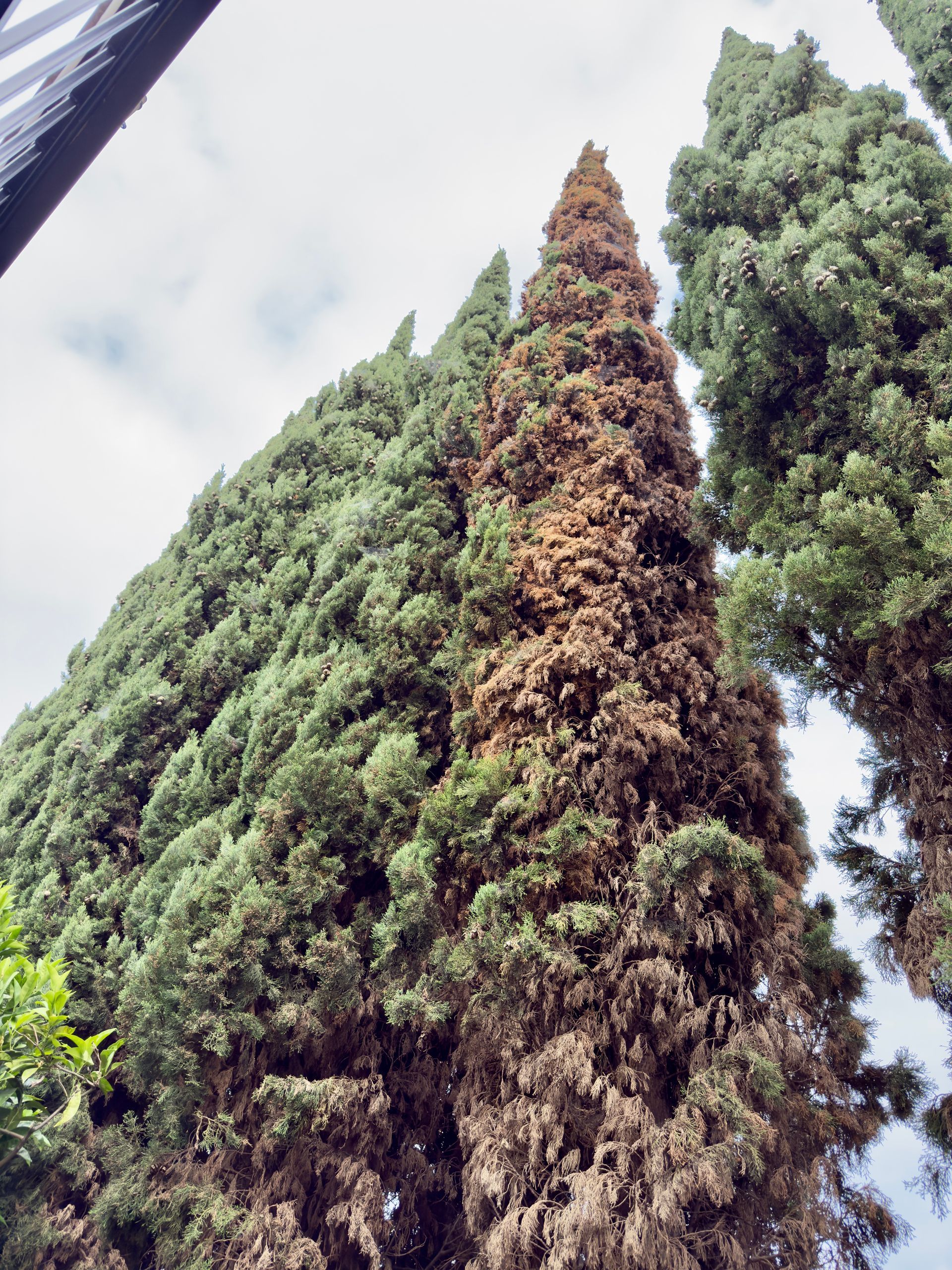
Italian cypress reminds me of the Queen of Hearts and her castle in Alice in Wonderland. They line the property boundaries of fine estates, work as an excellent screen species and require minimal maintenance. With their upright, erect structure, pruning is typically only needed to maintain a uniform shape when a branch over-elongates. Watering once established is minimal – a couple of deep watering events in the summer and you are good to go. It is, however, common for this species to develop secondary pests when improperly installed and maintained. Planting depth and water is crucial – this species can contract root rot, which commonly occurs when planting depth is too deep and watering cycles too frequent and shallow. They can also deal with a canker that produces toxins, wreaking havoc on mineral-and-water conducting tissue.

My duties as a tree consultant include being hyper-aware of how trees respond to human activity around the county, in general. For example, it's important that I notice if a particular species is exhibiting symptoms of a widespread problem, such as insect infestation or foliar disease. Or as another example, it might be equally important for me to understand how different collection of tree populations are affected by certain pruning methods. Insight that I might glean from potentially any property could be shared with a client or implemented on a project. Therefore, I am always looking at trees closely wherever I go. It's a TreeLife for me. Because I'm on the road much of many days, I use this as an opportunity to look at trees while traveling routine routes. Truly, I get to know all the varieties of trees along the I-15 and 78 freeway, and even keep an eye out for tree hazards along the CalTrans right-of-way. There are a many remnant Eucalypti that peak my curiosity. Though they are generally not planted these days, they will always be an emblematic and stately tree, for me. Long ago, they were selected for their hardiness and planned usefulness, but times have changed and now they're neglected and even despised. Then one day, I noticed that a particular type of Eucalypti had been pruned in locations that I knew had no tree budget, and thus, no tree maintenance monies to use for pruning. I was puzzled by signs that random silver dollar gums (Eucalyptus polyanthemos) had been stripped of foliage while nearby red gum (Eucalyptus camaldulensis) were untouched, with branches still overhanging the roadway. Even if there was a budget, I thought to myself, why did tree crews prune the wrong trees?