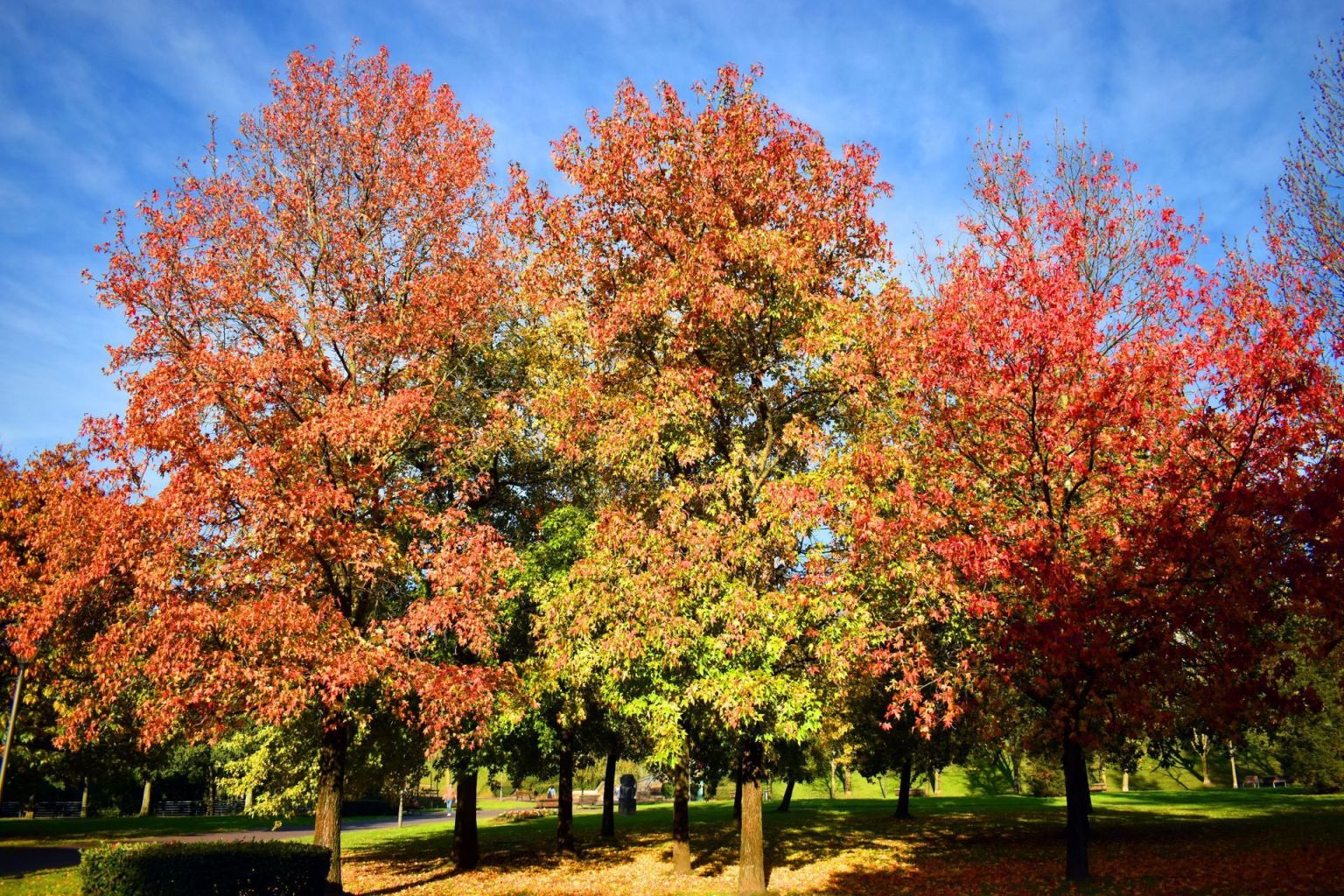
The American sweetgum (Liquidambar styraciflua) was a commonly planted tree in Southern California starting in the 1960s, and continuing into the 1980s, but their popularity peaked by the early 2000s.
They were one of the first species to reliably supply Californians with “fall color,” using cultivars like ‘Palo Alto’ or ‘Festival’ or ‘Burgundy.’
The excitement over their ‘fall color” made consumers oblivious to the potentially negative attributes the species possessed. Nowadays, arborists know that their root systems are generally aggressive, particularly in smaller growing-spaces. And many laypeople consider their spiky seedpods as a trip-and-fall hazard.
Despite the minor inconveniences that are inherent with any tree in an urban setting, the American sweetgum offers a growth-habit that is ideal for most sites. Their narrow, upright structure is a welcome contrast to trees with broad or round growth-habits.
Their crown structure is naturally narrow and relatively columnar, characterized by a single-stem leader (i.e. main trunk) from which limbs emanate radially. Tree crowns with this form are mechanically stronger than wide-spreading canopies. Basically, vertical growth is less likely to fail than horizontal growth.
In Southern California, American sweetgums are rarely, if ever, pruned properly.
Tree service crews should prune trees with widespread growth-habits by reducing crown width to essentially promote the natural growth-habit exhibited by the American sweetgum.
That is, crown width (i.e. lateral limb length) is rarely reduced and competing stems are almost never subordinated. A common pruning practice applied to this species is “crown-thinning,” which is not a well-defined term or an acceptable pruning objective. Modern arboriculture has moved away from crown thinning because it creates a branching structure that’s more likely to fail.
“Thinning” is the over-application of the branch removal cut. It’s commonly referred to as “lions-tailing,” as the remaining limbs resemble the archetypal lion’s tail. A long and skinny limb with a tuft of leaves at their tips grow weaker over time. Moreover, this style of pruning does not address crown defects like codominance or over-extended limbs.
The over-application of branch removal throughout the interior of the tree, or “thinning” cuts, on left has resulted in long and skinny branches, eliminated any ability to remediate structure without putting a significant tax on the tree’s system and has only increased the likelihood of branch or tree failure. This is called “lions-tailing,” or, “limb-tracing.”
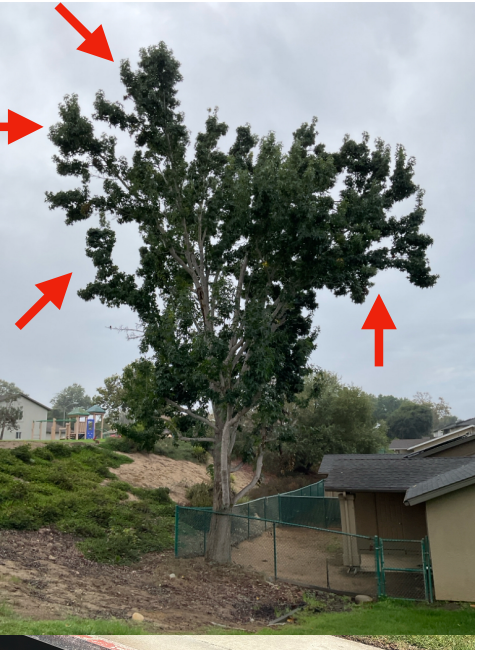
Co-dominant stem failure is a main contributor to the American sweetgum’s declining function in urban spaces, even though it can be prevented with subordination cuts. Pruning that doesn’t address crown defects, but in all actuality nurtures them, is unacceptable. Crown-thinning, i.e. lions-tailing, only increases the likelihood of failure.
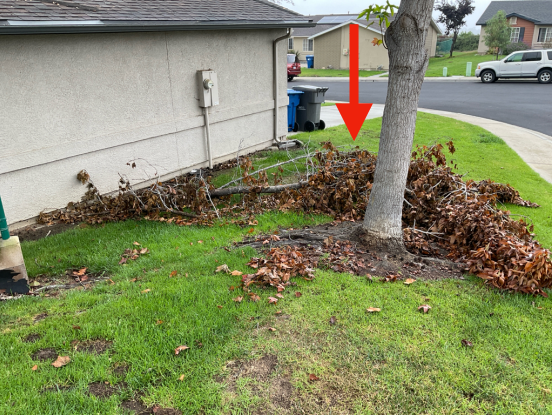
Photo above shows a branch failure from excessive thinning and no structural cuts being made during past pruning events. This is the long-term result of “thinning,” “lacing”, and/or “shaping,” which are undefined terms in arboriculture.
Unbeknownst to most tree owners, they’re paying money to shorten the useful lives of their trees.
The spirit of modern arboriculture is to optimize the performance and function of trees in urban spaces. But when “professionals” in the arboricultural industry do the wrong thing, people are more apt to favor tree removal.
Now, in 2025, the American sweetgum is often removed before other options are considered. “Time to phase them out,” they say. Without fail, a community filled with American sweetgum trees has been brutally pruning them for years, predisposing the species to multiple secondary disorders and early mortality.
Aggressively pruning sweetgums often leads to the proliferation of bacterial scorch, which constricts vascular function and causes dieback (dead branches and twigs). It usually brings a tree to the point of no return (this is death by a thousand paper cuts).
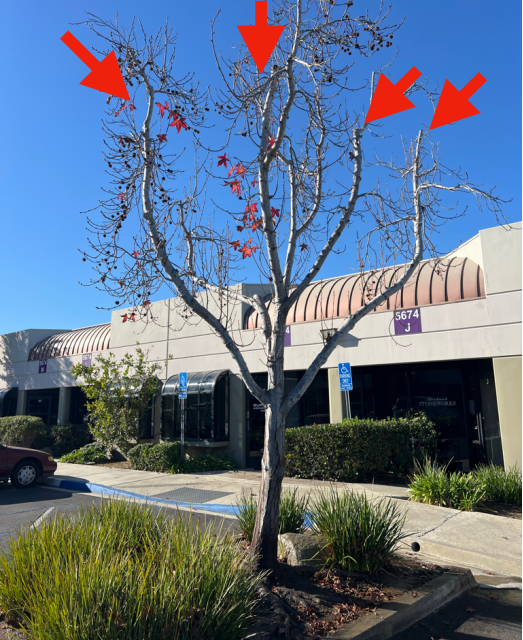
This young liquidambar (above) has already experienced too many heading cuts and too much thinning. Low scaffolding limbs are long and skinny, and are outcompeting the center leader.
Is their disease susceptibility and branch failure directly related to human error? Have these trees received a bad rap due to their improper care in nearly everywhere they’re planted?
Can the American sweetgum remain an urban forest staple in Southern California?
Below is a great example of a well-maintained Liquidambar styraciflua.
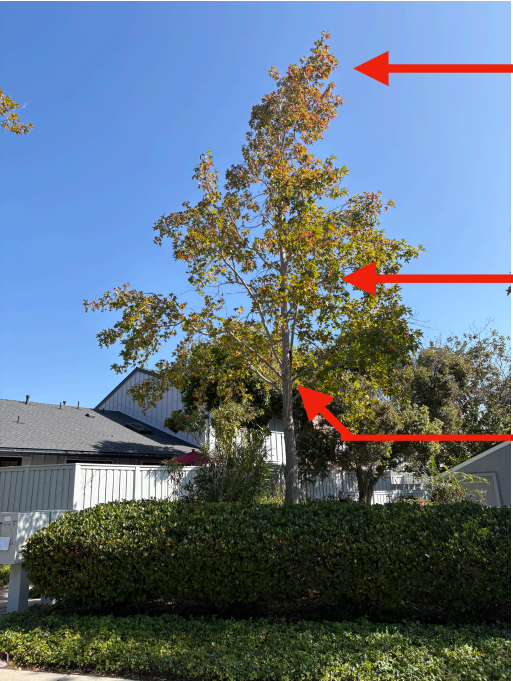
Notice the single, main leader intact and maintaining dominance, as well as the limbs emanating from the trunk radially (not over-elongated). Finally, notice that the branching structures along limbs are retained.
The answers to these questions are clear.
The American sweetgum can be an excellent tree. But just like any tree, they need proper care.
Here is a list of factors to keep in mind when planting trees:
- Planting technique — roots teased and directed away from the trunk
- Planting depth — the root collar should be exposed and root flare slightly above existing grade
- Soil medium — use parent soil
- Mulch — the root zone covered in naturally occurring leaf litter is ideal
- Water — twice a week the first year, once a week the second. Once established, don’t water in the summer
- Adjust the irrigation system as root system grows
- Proper structural pruning — reduction cuts preferred, removal cuts avoided
- Mechanical damage from mowers and string trimmers must the avoided
It seems pretty simple, right? But these ideas are rarely applied in most situations; and we see the species being removed more often than planted.
TreeLife is dedicated to promoting the health and longevity of urban forests.
Consider TreeLife, the Urban Forestry Experts, for any action activity around trees. Call TreeLife today!